
Inserting Formulas From HTML Equation Editor
From Assignments
To access the Equation Editor from the HTML Editor toolbar, click [+], then click [Equation].
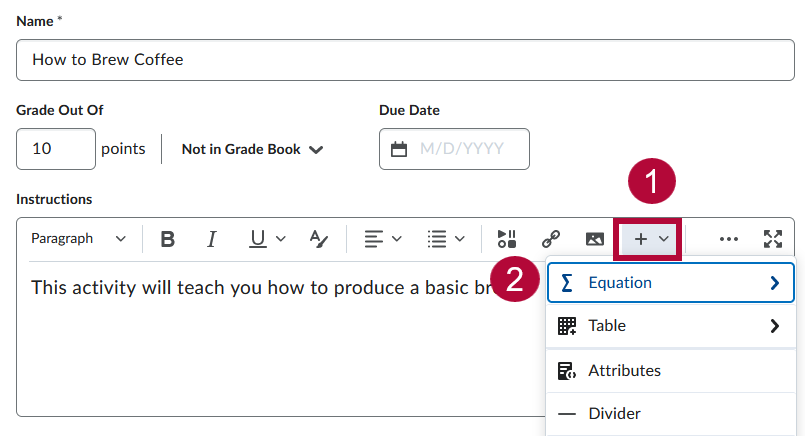
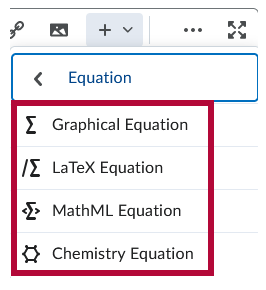
You will then be presented with the list of Equation Editors, which enables users to insert equations within the HTML Editor. It supports the inputs from:
- Graphical Editor
- LaTeX Editor
- MathML Editor
- Chemistry Equation Editor
From Quizzes
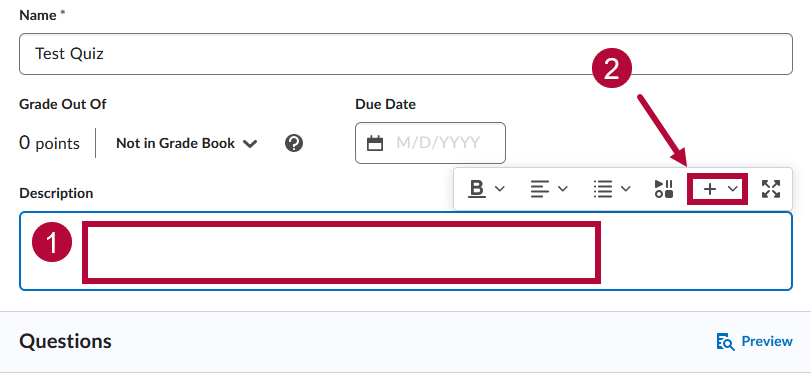
From the Edit Quiz page, click anywhere in the Description box, a popup toolbar will then appear. From the toolbar, click on [+], then click [Equation].
From the dropdown menu select the appropriate Equation Editor.
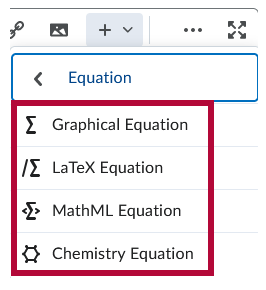
Graphical Equation Editor
The Graphical Equation Editor features a toolbar equipped with a selection of buttons. This toolbar provides the necessary elements to construct the equation. Each button in the Equation Editor toolbar opens a palette of related mathematical symbols. The Graphical Equation Editor offers 10 tabs of symbols, arrows, Greek letters and numbers, matrices, scripts and layouts, decorations, big operators, calculus, and context for creating math equations.

The following table displays the Tabs on the Graphical Equation Editor.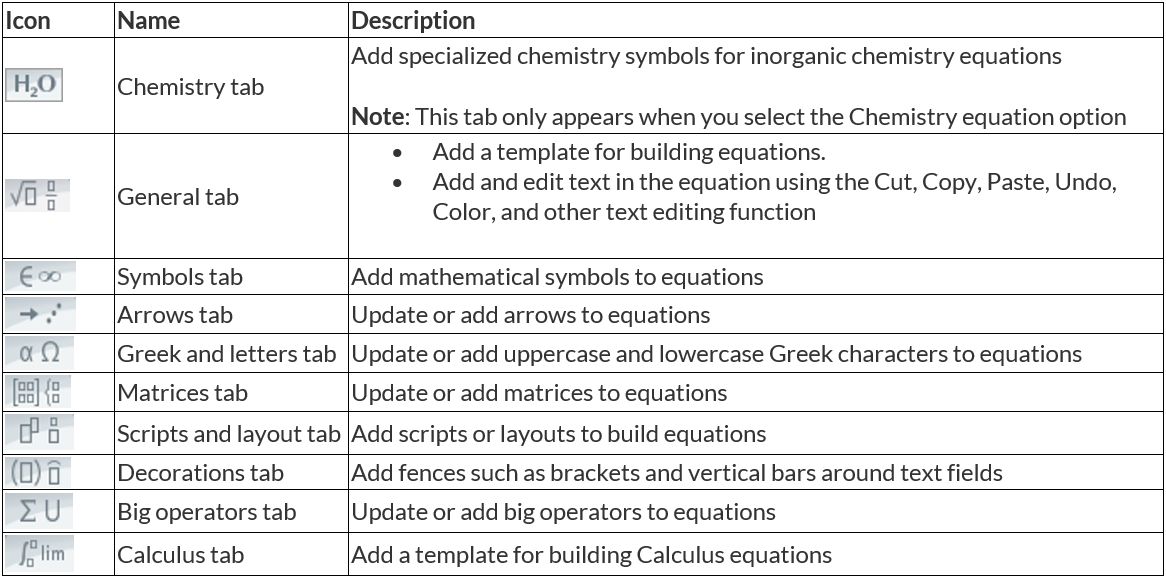
LaTeX Editor
LaTeX is a typesetting system based on TeX. There are two possible modes for LaTeX entry: text mode and math mode. D2L supports math mode only. If you add LaTeX using the Equation Editor:
- Most spaces and line breaks are not recognized and have to be specified with special commands.
- Empty lines are ignored, only one paragraph per formula.
- Each letter is considered to be the name of a variable and will be typeset as such. If you want normal text within a formula (normal upright font and normal spacing) then you have to enter the text using dedicated commands.
Insert the LaTeX command on the LaTeX Editor and the preview of the formula will be automatically generated. The LaTeX commands available are displayed on the link “Which LaTeX commands are supported?”

In the following table some examples of LaTeX commands are displayed:

MathML Editor
MathML is a standard adopted by the World Wide Web Consortium (W3C). It uses XML to describe mathematical notation by capturing both its structure and content. This enables MathML to support the visual display and assistive technology access. Its appearance is similar in structure to HTML. Unlike HTML, MathML is not designed to be hand-written. It is recommended that you compose equations in a visual editor and paste its MathML output into the Brightspace Equation Editor.

Chemistry Equation Editor
The Chemistry Equation Editor offers specialized chemistry symbols for inorganic chemistry formulas.
